

Every agency in Penrith will tell you Google Ads cost “depends”. Then they’ll send you a proposal with one big number on it and hope you don’t ask what’s inside it.
I’m Jamie. I run Umped out of Penrith and I’ve managed $25M+ in ad spend over nine years. So let me do the thing nobody selling you ads wants to do: break the real numbers down, line by line, with sources, so you walk into any sales call knowing exactly what you should be paying and what you’re being charged for.
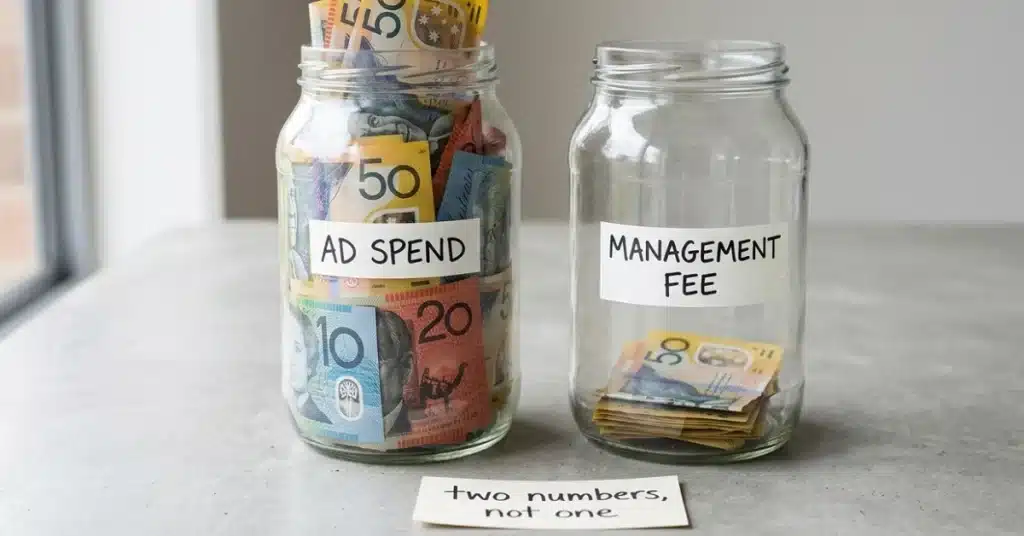
Short version up front. Running Google Ads in Penrith means paying two separate things: the ad spend that goes to Google (most local businesses start around $1,500 to $5,000 a month) and the management fee that goes to whoever runs it (a flat $800 to $2,000 a month for a competent operator). Anyone who blurs those two numbers into one is hoping you won’t notice the markup.
Here’s all of it.
How much do Google Ads cost in Penrith in 2026?
For most Penrith small businesses, the all-in cost lands somewhere between $2,300 and $7,000 a month: roughly $1,500 to $5,000 in ad spend paid to Google, plus $800 to $2,000 in management if you hire someone good. The exact figure swings on your industry and how competitive your keywords are.
That range isn’t me guessing. Across multiple Australian sources in 2026, the numbers converge: Australian businesses spend between $1,000 and $20,000 per month on Google Ads, with most small businesses starting in the $1,500 to $5,000 per month range, and management fees averaging an additional $800 to $2,000 per month depending on whether you use a freelancer or an agency.
The thing to burn into your brain before you read another word: there are two numbers, not one. Get them separated on day one of any conversation, or you can’t tell what you’re actually paying.
The two numbers nobody splits out for you
Your total Google Ads cost is ad spend plus management fee. They are completely different things and they go to completely different places.
| The cost | Where it goes | Typical Penrith range |
|---|---|---|
| Ad spend | Straight to Google, pays for the clicks | $1,500 to $5,000+/month |
| Management fee | To the agency or freelancer running it | $800 to $2,000/month flat |
| Setup fee (one-off) | To the agency, to build the account | $750 to $2,000 once |
Why does this matter so much? Because understanding these two separate costs is the key to planning your budget and evaluating ROI. When an agency quotes you “$3,000 a month, all in”, you have no idea how much is buying actual clicks and how much is their fee. Could be $2,000 of ads and $1,000 of management. Could be the reverse. You’re flying blind, and some shops like it that way.
Ask for the two numbers separately. A straight operator gives them to you without flinching. If they won’t split it, that’s your answer about how the rest of the relationship will go.
What’s a realistic cost per click in Penrith?
For most local Penrith businesses, expect $2 to $4 a click on Google Search. That’s the Australian average, and it holds for the kind of trades, retail and service businesses that make up most of Western Sydney. Most Australian businesses pay between $1.50 and $6.00 per click, with higher costs in competitive industries.
But “average” hides a brutal spread, because some industries pay through the nose. Here’s the real shape of it.
| Industry | Rough AU cost per click |
|---|---|
| E-commerce / retail | Around $1 to $2 |
| Local services / trades | $2 to $4 |
| Legal services | $6.40 to $10.61+ |
| Finance | Can exceed $13 |
| Insurance / mortgages | $44 to $55 |
The average cost per click for Google Ads in Australia is $2 to $4 for search campaigns, but legal services average $6.40 to $10.61 and finance can exceed $13. At the extreme end, insurance averages up to $54.91, mortgages $47.12, legal services $47.07, and loans $44.28 per click.
So if you’re a sparky in St Marys, your clicks are cheap and your budget stretches. If you’re a finance broker, brace yourself. The cost isn’t random, it tracks what a single customer is worth: a law firm can justify $10 a click because one case is worth thirty grand. A bloke fixing leaking taps cannot, and shouldn’t try.
Why do two businesses pay completely different prices for the same click?
Same industry, same keyword, wildly different cost per click. The difference is almost always Quality Score, and it’s the single biggest lever on what you pay.
Quality Score is Google’s rating of how relevant and useful your ad and landing page are. Score high and Google rewards you with cheaper clicks. Score low and you get punished. A Quality Score of 10 cuts your CPC by up to 50%, while a Quality Score of 1 to 3 increases it by up to 400%.
Read that again, because it’s the whole game. The same keyword can cost one business a fifth of what it costs another, purely on account quality. This is exactly where good management pays for itself and lazy management quietly robs you. A manager who lifts your Quality Score isn’t a nice-to-have, they’re the difference between $2 and $8 a click on the identical search.
That’s why “just spend more” is the laziest advice in this industry. The lever isn’t always budget. Often it’s the bloke running the account.
What should management actually cost, and which fee model isn’t a trap?
For most Penrith small businesses, competent management runs $800 to $2,000 a month as a flat fee, separate from spend. For most Australian small businesses, expect to pay $800 to $2,000 per month for competent Google Ads management, plus your ad spend to Google, with setup fees of $750 to $2,000 standard.
But the fee model matters more than the fee. There are three, and one of them has a conflict of interest baked straight into it.
Flat monthly retainer. A fixed fee no matter what you spend. Predictable, and the agency has no reason to inflate your budget. This is the honest one, and it’s the one I use.
Percentage of ad spend. The agency takes 10% to 20% of whatever you spend. Sounds fair until you think about it for two seconds. A percentage of ad spend is common at larger agencies, but it incentivises increasing your budget rather than improving your performance. If you’re spending $5,000 a month and getting great results, a percentage-based manager has no financial reason to tell you the budget could be lower, because the bigger your spend, the bigger their fee.
Sit with that. On a percentage model, your manager gets paid more when you spend more, whether or not it’s working. Their interest and yours point in opposite directions. I’m not saying every percentage agency rorts you. I’m saying the incentive is pointed the wrong way, and you should know that before you sign.
Hybrid. A lower base fee plus a small percentage or a performance bonus tied to actual results. Reasonable when it’s built around KPIs rather than spend.
My take, and I’ll be blunt: for most local businesses under $10,000 a month in spend, a flat fee is the only model where the person running your ads is on your side of the table. Karen from AgencyLand loves a percentage deal. Ask yourself why.
Is there a minimum spend, and how soon do results come?
No minimum. Google doesn’t force one. There is no minimum spend requirement; advertisers control their own daily and monthly budgets, making it accessible at any scale. That said, going too small is its own trap. If your cost per click is $4 and your daily budget buys two clicks, you’re not gathering enough data for anyone to optimise anything.
On timing, you’ll see clicks from day one, but real performance takes a beat. Clicks come from day one, with peak performance typically reached at 8 to 12 weeks. Anyone promising you a flood of cheap leads in week one is either new or lying. The first month or two is the algorithm and your manager learning what converts. Patience here is the difference between a campaign that compounds and one you kill too early.
The honest answer: what should you actually budget?
If you’re a typical Penrith local business, here’s the straight recommendation. Start with $1,500 to $3,000 a month in ad spend so there’s enough data to optimise, add $800 to $2,000 for a flat-fee manager who’s genuinely good, and expect a one-off setup fee around $750 to $2,000. Give it eight to twelve weeks before you judge it.
And don’t chase the cheapest option. The cheapest option isn’t always the best value, and the most expensive isn’t automatically better; what matters is that the person managing your campaigns has the experience to make your budget work. A manager who charges $500 more but halves your cost per lead has paid for themselves ten times over. The fee was never the real cost. Wasted spend is the real cost.
That’s how I price my own work: flat fee, two numbers always split out, no lock-in, no percentage games. Want to know what your specific setup would actually cost, no pitch, just the numbers? Have a look at the results first, then say G’day.
No middlemen. No contracts. No fluff.
Frequently asked questions
How much do Google Ads cost per month in Penrith?
Most Penrith small businesses spend $1,500 to $5,000 a month on ad spend paid to Google, plus $800 to $2,000 a month in management fees if they hire a specialist. That puts the all-in cost roughly between $2,300 and $7,000 monthly, depending on your industry and how competitive your keywords are.
What is the average cost per click in Australia in 2026?
The average is $2 to $4 per click on Google Search for most industries. Local services and trades sit in that band, e-commerce often pays $1 to $2, while competitive industries like legal, finance and insurance can run anywhere from $10 to over $50 per click because each customer is worth far more.
Is there a minimum spend for Google Ads?
No. Google sets no minimum and you control your own daily and monthly budget. That said, a budget too small to buy 15 to 20 clicks a day gives the campaign too little data to optimise. Most agencies recommend at least $1,500 a month in ad spend for meaningful results.
What’s the difference between ad spend and management fees?
Ad spend goes straight to Google and pays for the clicks. The management fee goes to the agency or freelancer running your campaigns. They’re two separate costs, and any provider who bundles them into one number is making it harder for you to see what you’re really paying them. Always get the two split out.
Should I avoid percentage-of-spend management fees?
Be cautious with them. Charging 10% to 20% of your ad spend means the agency earns more when you spend more, regardless of whether results improve, so their incentive points away from efficiency. For most businesses under $10,000 a month, a flat monthly fee removes that conflict and keeps the manager focused on performance, not budget growth.
How soon will Google Ads deliver results?
You’ll get clicks from day one, but peak performance usually takes 8 to 12 weeks as the campaign gathers data and gets optimised. Anyone promising a wave of cheap leads in the first week is overselling. The early weeks are about learning what converts, then scaling what works.