

Claude skills are the closest thing to cloning yourself that AI has produced so far. I run 97 of them across my agency. They write ad copy in my voice, audit accounts, draft reports, lint their own output before it ships.
But most people who try skills get a dud. Here is the short version before I get into it.
They open Claude, type “build me a skill for X”, save whatever comes back, and wonder why the output feels like every other AI on the planet. The skill is fine. It is just generic, because they gave it nothing to work from. A skill with no context is a fancier version of a blank prompt.
The fix is not a better prompt. It is feeding Claude the stuff only your business knows before you ask it to build anything.
I have made this mistake. I have also made the opposite work 97 times over. This is what actually separates a skill that changes how you work from one you forget you installed.
What is a Claude skill, in plain English
A skill is a saved workflow Claude loads automatically when the task matches.
You teach it once. It runs every time, without you pasting a prompt or naming the skill. You describe what you need, Claude picks the right skill and applies it.
Under the hood it is a folder with a SKILL.md file: a name, a description, and your instructions. The description is how Claude decides whether to reach for it. You can add reference files and scripts, but the core is that instruction file.
Anthropic ships a skill creator that writes skills for you in a normal chat. No code needed. That part is genuinely easy, and that is the trap. Because building the folder was never the hard bit.
Why do most Claude skills come out generic?
The skill is only as good as the context you give it.
Watch what most people do. They type “create a skill for writing our blog posts”, Claude produces a tidy, competent skill, they save it, done. Then the blog posts it writes sound like blog posts. Not their blog posts. Generic ones.
That is not Claude failing. That is Claude doing exactly what it was told with nothing to go on. It has never seen your writing, your rules, your customers, your offers. So it defaults to the average of everything it has read, which is the definition of forgettable.
I learned this the expensive way. My first voice skill for Umped just said “write in a casual Australian tone”. The output read like a Qantas safety video doing stand-up. Painful.
The version I run now holds the actual banned-words list, the punctuation rules, the three registers I switch between, real example lines, the named foil I use in aggressive content. Same task. The difference between the two is not the prompt. It is everything I fed it before the prompt.
Marketplace skills have the same problem, by the way. A skill built for the average business is built for nobody in particular. Install it raw and you get output that is technically correct and completely yours-free. The fix is the same either way: add your context.
What does “proper context” actually mean?
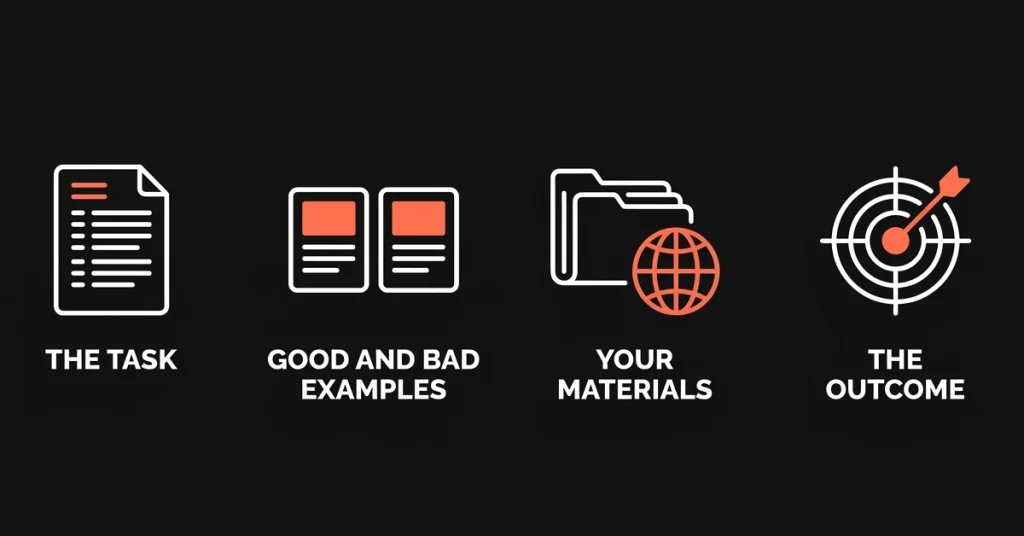
Before you ask Claude to build a skill, give it four things.
The task, in detail. Not “write our ads”. Spell out what a good one looks like, what a bad one looks like, the format, the length, the constraints. If you would coach a new hire through it, coach Claude through it.
Examples of good and bad output. This is the biggest single lever and the one people skip. Paste three ads you are proud of and one that made you cringe. Claude learns more from “this good, that bad” than from any adjective you can hand it. Show, do not describe.
Your real materials. Point it at your website. Give it the brand guide, the past reports, the SOPs, the customer language. Let it read the actual thing rather than your summary of the thing. A skill built off your real work behaves like it works at your company. One built off a description behaves like a contractor who read a one-paragraph brief.
The outcome you want. What is this skill for. What does done look like. What should never happen. Rules stick harder when Claude knows why they exist, so give it the reasoning, not just the rule.
Do that and the skill stops sounding like AI and starts sounding like your business. Skip it and no amount of prompting at the other end saves you.
Keep each skill doing one job
One skill that does everything does nothing well.
The instinct is to build a giant “marketing skill”. Resist it. A skill that tries to write ads and audit accounts and draft reports and answer emails will be mediocre at all four. Focused skills compose better than one bloated one.
My 97 are deliberately narrow. One writes Google ad copy. A separate one audits search terms. Another builds the client report. Each has room to hold deep, specific context because it is not trying to be five things at once.
Practical rule: if you cannot describe the skill’s job in one sentence without an “and”, it is two skills.
The part nobody talks about: linking them
A single skill is useful. Skills that call each other is where it gets silly good.
This is the bit that took my setup from handy to genuinely running the business. My skills reference each other. The ad-copy skill reads my voice skill first for the rules. The article skill checks my proof register before it makes a claim, then runs a linter over its own draft before handing it back.
You do not build that on day one. You build one skill, use it, notice where it keeps needing something another skill already knows, and wire them together. The library compounds. Each new skill makes the ones around it smarter, because they can lean on each other instead of repeating context.
That only works if each skill is properly built in the first place. Link 97 generic skills together and you get a very efficient generic-output machine. Context first, always. Then link.
How do you build your first Claude skill properly?
Here is the workflow that works.
Pick one task you do constantly. Email drafting, proposals, meeting notes, reports. High-frequency, repeatable, and you know what good looks like. That last part matters: you cannot give Claude a standard you do not have yourself.
Gather your context before you open the skill creator. Three good examples, one bad one, your brand guide or style rules, a link to your site, and a plain-English description of what the skill is for.
Let Claude interview you. Do not just say “build it”. Ask it to interview you first, one question at a time, about the edge cases and constraints you have not thought of. This consistently beats jumping straight to a finished draft, because it drags out context you did not think to give.
Then build, test on a real task, and fix what is off. The first draft is rarely the best. Run it on live work, see where the output drifts, feed the fix back in. A skill gets good through use, not on the first go.
That is the whole game. The folder takes five minutes. The context is the job, and it is the bit that decides whether this thing changes how you work or gathers dust.
The honest verdict
If you build one skill and give it real context, it will beat ten skills you rushed.
I am not going to tell you skills will fix a business that has no process. They will not. A skill encodes how you already do something well. If the process is a mess, you get a fast, consistent mess. Sort the process, then encode it.
But if you know what good looks like and you are tired of re-explaining it to Claude every single time, this is the highest-leverage hour you will spend in the tool. Build one properly. Use it for a week. You will build the next five before the week is out.
Not by fluke. Because you gave it something real to work from.
FAQ
Do I need to know how to code to build a Claude skill?
No. Anthropic’s built-in skill creator builds the skill for you in a normal chat, and you can use it without writing a line of code. Coding only comes in if you want a skill that runs custom scripts. For most business tasks, plain instructions and good examples are all you need.
Why does my Claude skill produce generic output?
Because it was built with no context. If you told Claude to build a skill without giving it your examples, brand rules, real materials, and the outcome you want, it defaulted to the average of everything it has read. The fix is to feed it your actual work before asking it to build, not to keep tweaking the prompt afterwards.
How many Claude skills should a business have?
As many focused ones as you have repeated tasks, rather than a few broad ones. Multiple narrow skills compose better than one that tries to do everything. Start with a single skill for your most common task, then add one each time you notice yourself re-explaining a workflow to Claude.
What is the difference between a skill and a saved prompt?
A saved prompt you have to find, paste, and adjust every time. A skill Claude loads automatically when the task matches, with no pasting and no naming it. It is a saved prompt made permanent, and it can carry reference files and scripts a plain prompt cannot.
Can Claude skills work together?
Yes, and it is where they get powerful. Skills can reference each other, so one skill reads another’s rules before it runs, or checks a second skill’s data before making a claim. Build each one properly first: linking generic skills just produces generic output faster.
How long does it take to build a Claude skill?
The folder itself takes a few minutes with the skill creator. Gathering the context that makes it good, your examples, rules, and materials, is the real work and where the value sits. Budget your time for the context, not the build.