

Most online stores start Google Ads in the wrong order, split the budget by vibes, then judge the whole channel on a number that means nothing without their margins.
So here’s what you need to do in the order it should actually happen.
Google Ads for eCommerce is not one thing. It’s six campaign types doing six different jobs, and the order you launch them in decides whether the account compounds or stalls. Shopping and brand Search first, because that’s demand you already have. Non-brand Search and remarketing next. Performance Max once your tracking and feed are clean enough to feed it. YouTube and Demand Gen last, if at all. Get the order wrong and you spend six months paying Google to teach you what a properly sequenced account learns in six weeks.
Google Ads for eCommerce at a glance
| Campaign type | What it’s for | Typical CPC (AUD) |
|---|---|---|
| Shopping | Buyers searching for your product right now | $0.59 to $0.95 |
| Search (brand) | Defending people already looking for you | Usually well under $1 |
| Search (non-brand) | Category and problem queries | ~$1.67 for ecommerce |
| Performance Max | Blended reach across every Google surface | ~$0.67 |
| Display remarketing | Cart abandoners and past visitors | ~$0.63 |
| Demand Gen and YouTube | Creating demand that doesn’t exist yet | Bought on views and impressions |
Sources: smec Q1 2026 (€650M+ of European ecommerce spend), LocaliQ data across $2.8B in spend (Q1 2026), Store Growers (January 2026). Converted at USD $1 = AUD $1.44 and €1 = AUD $1.64, July 2026. Global panels, so treat them as a compass. Australian CPCs in our client accounts sit in a similar band, and no rigorous Australia-only dataset exists.
Does Google Ads actually work for eCommerce stores?
Yes, and the benchmarks proving it disagree with each other so violently that they’re almost useless. Triple Whale’s panel put the median ecommerce ROAS around 2.04. smec’s Q1 2026 Market Observer tracked median ROAS between 5.0 and 6.2 through late January and February, peaking near 7.0. Google’s own documentation uses 2:1 as a baseline. Various 2026 round-ups land on 3.5x. Same channel, same year, numbers three times apart.
That spread isn’t sloppy research. It’s the actual answer: ROAS benchmarks are meaningless without margins. A 2X ROAS is a disaster on 30% margins and a decent living on 70%. Your break-even is 1 divided by your gross margin, and everything above that line is the only benchmark that matters. Chasing someone else’s ROAS number is how stores talk themselves out of a profitable account or into an unprofitable one.
What is not in dispute: Google Ads catches people who have already decided to buy something and are typing what it is. No other channel starts that far down the funnel. The question was never whether it works. It’s whether your margins survive the click.
Which Google Ads campaign types should an online store run?
Six exist. Most stores need three or four, and almost nobody needs all six on day one.
- Shopping. Product tiles with an image and price, matched to searches from your product feed rather than keywords. Cheapest high-intent traffic in the account at roughly $0.59 to $0.95 a click. This is the backbone of nearly every ecommerce account we run. The full breakdown lives in our guide to Google Shopping ads in Australia.
- Brand Search. Text ads on your own business name. Cheap, high converting, and the subject of the longest-running argument in paid ads (more on that below).
- Non-brand Search. Category queries, problem queries, competitor queries. Around $1.67 a click for ecommerce, which is the cheapest of 16 industries in LocaliQ’s data, mostly because ecommerce buyers convert on Shopping instead.
- Performance Max. One campaign running across Shopping, Search, YouTube, Display, Gmail and Discover, driven by Google’s AI. Powerful when fed properly, expensive when fed rubbish.
- Display remarketing. Chasing people who visited and left. Dirt cheap at roughly $0.63 a click, and the closest thing to free money in the account when the audience is set up properly.
- Demand Gen and YouTube. Creating demand rather than catching it. Real, but it’s the last thing a store with unsolved feed problems should be spending on.
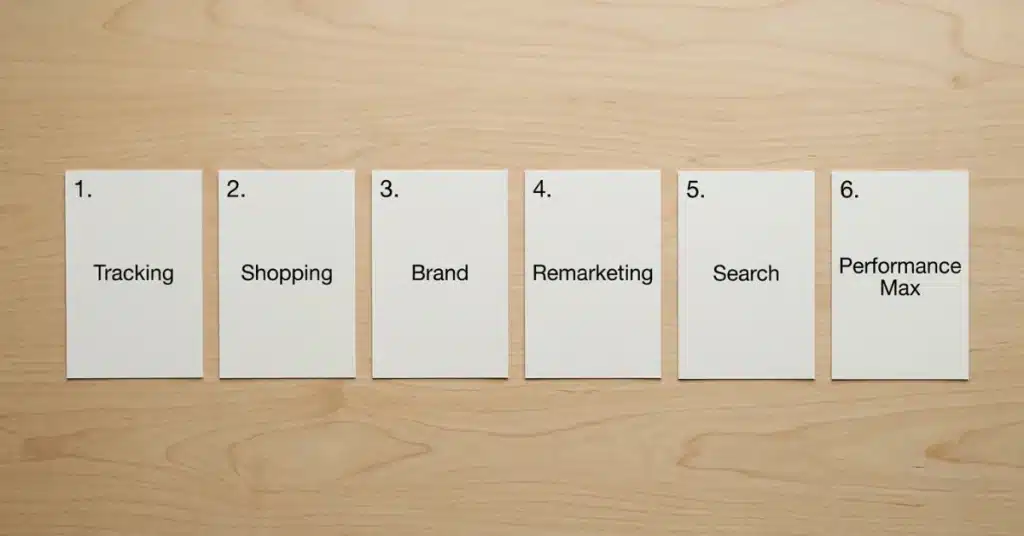
What order should you launch Google Ads campaigns in?
Sequence beats selection. Here’s the order that works:
- 1. Fix tracking first. Not a campaign, but it’s step one and it’s non-negotiable. Purchases recorded once, with values, ideally with enhanced conversions. Every automated decision Google makes afterwards is built on this data, including the wrong ones.
- 2. Shopping and brand Search. Demand that already exists, pointed at your products and your name. These two campaigns will usually carry the account for the first month while everything else is still learning.
- 3. Remarketing. Cheap, and by now you have traffic to remarket to. Turning this on before you have visitors is like opening a shop with no stock.
- 4. Non-brand Search. Once you know from your Shopping search terms what people actually call your products, you can build Search around the language that converts, rather than the language your product team uses internally.
- 5. Performance Max. Only once tracking is solid and you have conversion history for it to feed on. PMax with clean data is genuinely strong. PMax with dirty data spends confidently in the wrong direction, and its reporting will not tell you where.
- 6. Demand Gen or YouTube. When the rest of the account is profitable and you want more volume than search demand can supply.
How should you split your Google Ads budget?
There’s no universal split, but there is a useful starting shape for a store spending $2k to $10k a month:
- Roughly 50 to 60% into Shopping or PMax. Whichever you’re running, this is where product-level intent lives.
- 5 to 10% into brand Search. It should be cheap. If brand is eating 30% of your budget, you’re not defending your name, you’re buying traffic you already had.
- 20 to 30% into non-brand Search. Your growth lever, and the most expensive place to be sloppy.
- 5 to 10% into remarketing. Small budget, disproportionate return.
- Whatever’s left into testing. Zero is an acceptable answer here in month one.
Then move it. Budget splits are a starting position, not a policy. The account tells you where the money should go by about week six, provided the tracking is honest enough to be believed.
Should eCommerce stores bid on their own brand name?
Usually yes, and the reason is competitors, not incrementality. If nobody else bids on your name, brand Search is mostly buying clicks you’d have received for free. The moment a competitor bids on it, your listing sits below theirs on a page where someone typed your business name specifically.
The honest position: brand campaigns are insurance, not growth. Keep them cheap, keep them tight, and if you want to know whether yours are actually incremental, run a holdout test rather than arguing about it. Most agencies won’t suggest that, because brand campaigns make their reported ROAS look magnificent.
Is Google Ads worth it for a small Australian online store?
Below about $2k a month in ad spend, it’s tight. Not because small stores can’t compete, but because Smart Bidding needs conversion volume to learn, and a small budget spread across a large catalogue gives it almost nothing to learn from. The stores that struggle at low budgets are rarely too small. They’re too thin: not enough conversions in one place for the system to find a pattern.
There’s a second thing worth knowing before you set expectations. In smec’s Q1 2026 data, Amazon held a stable 34 to 37% of Shopping impression share, with eBay around 17 to 18% and Temu near 20%. That’s the auction you’re walking into. It doesn’t mean you lose, it means you win on the specific searches where a giant marketplace is a worse answer than you are: your niche, your expertise, your product range. Trying to out-broad Amazon is a fast way to donate your margin.
Small stores win Google Ads by being narrow. Tight catalogue focus, sharp product titles, honest tracking, and a bid strategy that isn’t trying to be everywhere.
What actually breaks eCommerce Google Ads accounts?
Not bad bids. It’s almost always one of these:
- Tracking that lies. Purchases counted twice, or counted without values, or firing on a page load. The algorithm optimises toward whatever you told it, including the fiction.
- PMax eating Shopping. Running both without structure means PMax quietly wins the same auctions your Shopping campaign was already winning, and reports them as new. Your spend goes up, your sales don’t, and the reporting says everything is fine.
- One blended ROAS target. A single target across products with 20% and 70% margins subsidises your worst products with your best. Structure by margin, not by category.
- Nobody reading the search terms. Both Shopping and PMax show you what queries you’re actually buying. Very few accounts get that report read monthly, which is exactly why the waste stays invisible.
- Changing everything at once. Every major change resets part of the learning. Accounts that get “optimised” weekly by someone proving they’re busy never leave the learning phase.
Where Meta fits
Quick note, because the question always comes: Google catches existing demand, Meta creates it. A store running only Google is limited to the number of people already searching for what it sells, which is a ceiling, not a strategy. A store running only Meta pays to introduce itself to everyone, including the people who were about to search for it anyway.
Most Australian stores we work with run both, with Google catching the intent and Meta filling the top of the funnel. That’s a separate article, and it’s coming.
Should you run Google Ads for your store yourself?
If you’re under roughly $2k a month, learning it yourself is a fair call. The sequence above will get you further than most paid courses, and Google’s documentation is free.
Once real money is moving, the gap between a sequenced account and a scattered one is worth multiples of any management fee. That’s when a specialist stops being a cost and starts being maths.
If you get there, we’re an eCommerce ads agency running Google and Meta for Australian online stores, and nothing else. You deal with me and my small team directly. No middlemen. No contracts. No fluff.
Say G’day if you want a second opinion on your account. If the answer is that your tracking needs a tidy-up you can do yourself, I’ll tell you that too.
Google Ads for eCommerce FAQ
What is the difference between Google Ads and Google Shopping?
Google Shopping is a campaign type inside Google Ads, not a separate platform. Google Ads is the whole system: Search, Shopping, Performance Max, Display, YouTube and Demand Gen. Shopping is the product-tile format that pulls from your Merchant Centre feed. Every Shopping ad is a Google ad, but not every Google ad is a Shopping ad.
Do you need Google Merchant Centre to run Google Ads for an online store?
For Shopping and Performance Max with product feeds, yes. Merchant Centre is where your catalogue lives and Google reads it from there. For text-based Search campaigns you don’t need it. In practice, any serious ecommerce account runs Merchant Centre, because Shopping is where the cheap high-intent traffic sits.
How many campaigns should an eCommerce store run?
Fewer than you think. Most stores under $10k a month in spend run three to five: Shopping or PMax, brand Search, non-brand Search, and remarketing. Splitting a modest budget across a dozen campaigns starves every one of them of the conversion data Smart Bidding needs to work.
Does Google Ads work for stores selling low-priced products?
It can, but the maths is unforgiving. At a $30 order value and 40% margins you have $12 to acquire a customer, and clicks cost $0.60 to $1.67. That’s roughly 10 to 20 clicks per sale before you’re upside down. Low-priced stores that win do it on repeat purchase value or basket size, not on first-order ROAS.
Do you need a big product catalogue for Google Ads?
No. Single-product stores run Google Ads profitably every day. A large catalogue helps Shopping and PMax find more matching searches, but it also spreads a small budget thinner. A tight catalogue with excellent product data beats a huge one with vague titles every time.
Is Performance Max replacing Standard Shopping in 2026?
Not yet, and Standard Shopping is still the right starting point for most accounts because you can see the search terms and control the negatives. Adoption of PMax keeps climbing, and it’s genuinely strong on clean data. Treat it as the scaling layer, not the starting layer.