
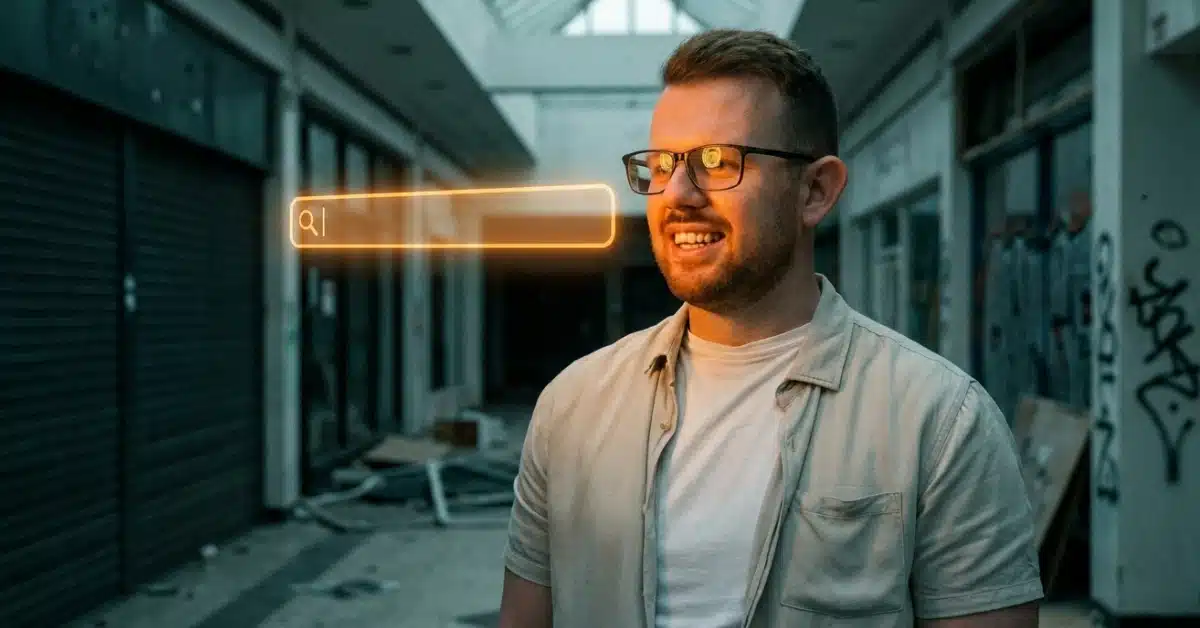
60% of searches now don’t end in a click.
Sit with that for a second. Six out of ten times someone searches, they get their answer and leave without ever visiting a website. Not yours. Not your competitor’s. Nobody’s.
I’ve been running paid ads for 9+ years and I’ve never seen a shift like this one. The last six months alone have moved faster than the previous five years. So here’s the short version before I get into it: search isn’t dying, but the click is. People are getting answers from AI Overviews, ChatGPT and Claude instead of clicking through to websites. The businesses that win from here are the ones AI recommends, and the ones showing up inside those AI conversations with ads. Everyone else is fighting over a shrinking pile of clicks.
Let’s break down what’s actually happening.
The numbers at a glance
| Stat | Figure | Source |
|---|---|---|
| Google searches ending without a click | Roughly 60% (58.5% US, 59.7% EU) | Semrush zero-click study, 2025 |
| Consumers relying on zero-click results in at least 40% of their searches | 80% | Bain & Company, Feb 2025 |
| Estimated drop in organic web traffic from the zero-click shift | 15% to 25% | Bain & Company, Feb 2025 |
| Zero-click rate on news searches, May 2024 to May 2025 | 56% up to 69% | Similarweb |
| ChatGPT weekly active users | 900M+ | OpenAI, 2026 |
What is a zero-click search?
A zero-click search is when someone types a query into Google, gets their answer directly on the results page, and never clicks through to a website. AI Overviews, featured snippets, knowledge panels, the local map pack. Google answers the question itself, and the searcher moves on with their day.
It used to be a small slice of searches. Quick facts, weather, currency conversions. Now it’s the majority. Semrush’s 2025 study put it at 58.5% of US searches and 59.7% in the EU, and the trend line only points one way.
Why did people stop clicking?
Two things happened at once, and they compound each other.
First, Google started answering questions itself. AI Overviews sit at the top of the results page and summarise the answer before you ever see a blue link. AI Mode goes further again. It’s Google’s closest thing to a chatbot built straight into search. When the answer is right there, why click?
Second, and this is the bigger one, a huge chunk of research moved off Google entirely. People are asking ChatGPT and Claude the questions they used to type into a search bar. Comparing tradies. Researching orthodontists. Shortlisting software. ChatGPT now has over 900M weekly active users, and OpenAI says Australian usage more than doubled in the 12 months before ads launched here.
The behaviour I’m seeing across client accounts backs this up. Search still happens, but it’s become the shallow first touch. The deep research, the comparing, the “which one should I actually pick” conversation, that’s happening inside AI. By the time someone lands on a website, a lot of the decision is already made.
What does this mean for your Google Ads?
Here’s the honest practitioner view, because I stare at these accounts every day.
Google Ads still works. Search intent hasn’t vanished, it’s redistributed. But across a number of the accounts I manage, I’m seeing the pattern the data predicts: traffic drop-offs appearing in places they didn’t used to, and conversion rates softening on research-heavy queries. People use the search as a basic starting point, then go deeper with AI before they commit.
That doesn’t mean pull budget. It means the job description changed. Your ads and landing pages now catch people later in the journey, often after an AI has already framed their options. If your landing page contradicts what ChatGPT just told them, or says nothing an AI couldn’t summarise better, you lose. Message match and proof matter more than they ever have.
Meanwhile, Karen from AgencyLand is still sending monthly reports celebrating impressions like it’s 2019.
Is Google search dying?
No. And anyone telling you to abandon Google is selling something.
Google still handles billions of searches a day, and high-intent commercial queries (“emergency plumber Penrith”, “orthodontist near me”) still convert through search and search ads. Bain’s research found the zero-click shift has cut organic web traffic by an estimated 15% to 25%, which is brutal for publishers and blogs, but bottom-of-funnel local and commercial intent is holding up far better than informational content.
What’s dying is the old assumption that visibility equals clicks equals traffic equals customers. Visibility now includes being the answer inside an AI response, where no click ever happens. Your brand can influence a buyer without a single session showing up in your analytics.
How do you stay visible when nobody clicks?
Three plays, in order of urgency.
1. Be the recommendation. When someone asks ChatGPT or Claude “who’s the best roof restorer in Western Sydney“, a small set of businesses get named. That’s not luck. AI engines pull from structured, credible, well-cited sources: your site content, reviews, third-party mentions, local listings. Getting your business into those answers is its own discipline now, and it rewards the same things good marketing always did. Real proof, real specificity, consistent presence.
2. Advertise inside the AI. ChatGPT ads went live for Australian businesses in April 2026. Ads appear beneath relevant conversations for free-tier users, matched on conversational context rather than keywords. It’s early, the targeting is thin, and it’s a reach play rather than a performance channel right now. But being early on a new ad surface has historically been where the cheap attention lives. I’ve written a full breakdown of how ChatGPT ads work and who should test them.
3. Keep winning the clicks that remain. Fewer clicks means each one costs more attention to win. Sharper ads, faster pages, proof up front. The fundamentals didn’t change, the margin for sloppiness did.
The honest verdict
The shift is real, it’s accelerating, and it’s the biggest change to how people find businesses since Google itself. But the response isn’t panic, it’s reallocation. Keep the search campaigns that print money running. Fix the landing pages that an AI-briefed buyer will judge in seconds. Start building the presence that gets you named in AI answers, and watch the ChatGPT ads space closely because the land grab is on.
Search didn’t die. The click did. Plan for that and you’re ahead of 90% of your competitors, most of whom haven’t noticed yet.
FAQ
What percentage of Google searches are zero-click?
Roughly 60%. Semrush’s 2025 study found 58.5% of US searches and 59.7% of EU searches end without a click to any website, and Bain’s research landed at about the same figure. The rate is higher again on queries that trigger AI Overviews.
Do zero-click searches affect paid ads or just SEO?
Both. Organic takes the bigger hit, but paid search feels it too. Click-through rates soften on queries where AI Overviews appear, and searchers increasingly treat ads as one input before finishing their research inside AI tools. Bottom-of-funnel commercial queries are holding up best.
Should I stop investing in my website because of zero-click searches?
No. Your website is now the source material AI engines read and cite, and it’s still where AI-briefed buyers land to verify before contacting you. A thin website hurts you twice: it won’t get cited, and it won’t convert the visitors who do arrive.
Are people really using ChatGPT instead of Google?
For research, increasingly yes. ChatGPT has 900M+ weekly active users and Australian usage more than doubled in the year to 2026. Google still dominates quick lookups and high-intent local queries, but comparison and consideration research is shifting into AI conversations.
Can my business advertise on ChatGPT in Australia?
Yes. ChatGPT ads launched in Australia in April 2026 for users on free and Go tiers. Ads are matched to conversation context rather than keywords, and the channel currently suits awareness goals more than direct response. It’s early days, which is exactly why it’s worth watching.