

Google catches people who already want your product. Facebook finds the ones who don’t know it exists yet. For a Shopify store, that second job is the harder one, and it’s where most of the money gets wasted.
Here’s how to run it without lighting your budget on fire.
Facebook ads for Shopify work by interrupting people who weren’t looking for you, which means the creative does the heavy lifting and the technical setup decides whether you can even measure it. Get the pixel and Conversions API connected properly, feed your catalogue in, and let Meta’s system find buyers from your product data. The median Meta ecommerce ROAS sits around 1.86 (Triple Whale, ~35,000 brands, 2025), which sounds underwhelming until you remember that number is dragged down by every store running broken tracking and boosted posts. The stores doing it properly sit well above it.
Everything below is how to be one of those stores.
Facebook ads for Shopify at a glance
| Metric | Benchmark (AUD) |
|---|---|
| Median eCommerce CPC | ~$1.60 |
| eCommerce CPC (Nov peak to Jan trough) | $1.90 down to $1.22 |
| Median eCommerce CPM | ~$19.40 |
| Median eCommerce CPA | ~$55 |
| Median eCommerce ROAS | 1.86 |
| Advantage+ Shopping vs manual CPA | ~32% lower |
Sources: Triple Whale (~35,000 ecommerce brands, full-year 2025), Superads ($3B in ad spend tracked, Jan 2025 to Jan 2026), digitalapplied 2026 benchmarks. Converted at USD $1 = AUD $1.44, July 2026. Global panels, so treat them as a compass. No rigorous Australia-only Meta dataset exists, and these figures move hard with your margins and category.
Do Facebook ads work for Shopify stores?
Yes, but not the way Google does, and confusing the two is the single most common reason stores decide Facebook “doesn’t work”. Google Ads catches existing demand: someone types “canvas weekender bag” and you show up. Facebook creates demand: someone scrolling their feed sees a bag they didn’t know they wanted. That means Facebook usually shows a lower ROAS on paper than Google, because it’s doing the harder, earlier job of introducing you to people.
The median Meta ecommerce ROAS is 1.86 (Triple Whale, 2025). Judge that against your margins, not against your Google number. A store running 4X on Google Shopping and 2X on Facebook isn’t failing at Facebook, it’s using each channel for what it’s good at. The Google number looks better partly because it’s harvesting demand that Facebook and everything else created.
Where Facebook genuinely doesn’t work: stores with thin margins that can’t survive a $55 average cost per acquisition, stores with no usable creative, and stores measuring it with a broken pixel and blaming the channel for numbers that were never real.
How do you connect Facebook ads to Shopify?
The plumbing matters more than any targeting decision you’ll make, because if the tracking is wrong, everything downstream is guesswork. In order:
- 1. Install the Facebook & Instagram app from the Shopify App Store. This is Meta’s official channel. It connects your store to your Meta Business account and handles the basic pixel install.
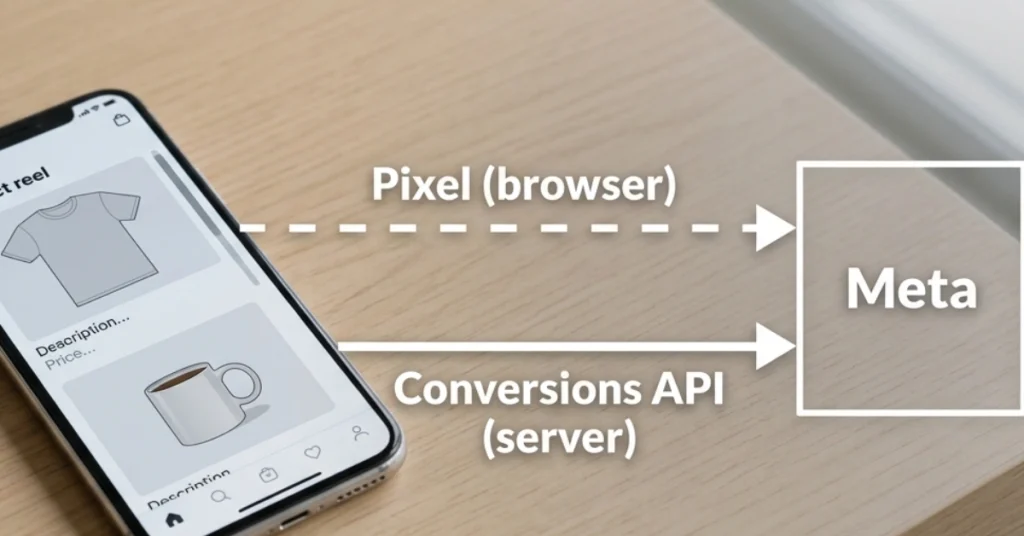
- 2. Connect your Meta Pixel and turn on the Conversions API. The pixel tracks browser-side, the Conversions API (CAPI) tracks server-side. You want both, because iOS privacy changes blind the pixel to a chunk of conversions that CAPI still sees. The Shopify app can set up CAPI natively, and this one step recovers conversions most stores don’t realise they’re losing.
- 3. Sync your product catalogue. The app pushes your Shopify products into a Meta catalogue, which is what powers catalogue ads and Advantage+ Shopping. Check what actually synced. Missing images, wrong prices and out-of-stock products showing as available are all common.
- 4. Verify your domain and set up Aggregated Event Measurement. Verify your Shopify domain in Meta Business Settings and prioritise your eight conversion events, with Purchase at the top. Skip this and iOS users fall out of your reporting entirely.
- 5. Confirm it’s working before you spend. Use the Meta Pixel Helper and Events Manager to check that a test purchase fires once, server-side and browser-side deduplicated, with the correct value. If it doesn’t, fix it now, because no amount of creative saves an account that can’t measure a sale.
Karen from AgencyLand boosts a post from the Instagram app and calls it a Facebook strategy. That’s not tracking, that’s donating.
What Facebook campaign types should a Shopify store run?
Fewer than the interface tempts you into. Most Shopify stores need three:
- Advantage+ Shopping (ASC). Meta’s AI-driven ecommerce campaign. You give it your catalogue, your creative and a budget, and it finds buyers across placements. In 2026 it delivers roughly 32% lower CPA than manually configured campaigns across ecommerce (digitalapplied, 2026), and for most stores it’s now the core prospecting engine rather than an experiment.
- Catalogue ads (Advantage+ Catalogue, formerly Dynamic Product Ads). These pull products straight from your catalogue and show people the exact items they viewed or added to cart. This is your retargeting workhorse and usually your highest-ROAS campaign, because it’s showing warm buyers the thing they already looked at.
- A prospecting or testing campaign. Somewhere to test new creative and audiences before promoting winners into ASC. Small budget, constant creative flow.
That’s it for most stores under $20k a month in spend. Interest-stacking, twelve ad sets, and lookalike ladders were a 2020 strategy. Meta’s system in 2026 wants broad targeting and creative volume, not a clever audience architecture you built to feel busy.
Why creative is the whole game now
Here’s the shift most store owners haven’t caught up to. Meta’s targeting used to be the lever you pulled. Now the AI handles targeting better than you can, and the only real input left in your control is the creative. That’s not a slogan, it’s where the performance difference actually lives.
The leading indicators are hook rate (do people stop scrolling in the first three seconds) and hold rate (do they keep watching). When a creative’s hook rate drops, the CPA spike is already coming five to seven days later. Stores that win on Facebook aren’t the ones with the cleverest targeting, they’re the ones shipping fresh creative every week and killing fatigued ads before the CPA tells them to.
Practically, for a Shopify store, that means: a steady stream of short video and motion, real product-in-use footage over polished studio shots, user-generated style content that doesn’t look like an ad, and enough variations that Meta’s system has something to choose between. One perfect ad is worth less than ten decent ones the algorithm can test.
How much do Facebook ads cost for a Shopify store in Australia?
You set the budget, so the real questions are what a result costs and what you need to spend to give Meta enough data. Across ecommerce, the median cost per click sits around AUD $1.60 and the median cost per acquisition around AUD $55 (Superads and Triple Whale, 2025), though CPA swings hard by category: roughly AUD $43 for lifestyle products up to AUD $71 for electronics.
On budget, Meta’s system needs about 50 conversions per week per ad set to exit the learning phase and optimise properly. Work backwards from your CPA: at a $55 CPA, 50 conversions is around $2,750 a week of spend to fully feed one ad set, which is why we usually tell Shopify stores that Facebook gets serious somewhere north of $3k a month. Below that, Advantage+ Shopping (which pools learning across the whole campaign instead of per ad set) is the more forgiving structure.
And the same Q4 warning as every channel: Meta CPCs peak around AUD $1.90 in November and reset to AUD $1.22 by January (Superads, 2025). CPMs can run two to three times the annual average across Black Friday and Cyber Monday. Buyers are there, but so is every other store, so budget for it rather than being surprised by it.
Facebook or Google for your Shopify store?
Wrong question, and the answer is almost always both. Google catches the demand, Facebook creates it, and a store running only one is either capped by existing search volume (Google alone) or paying to introduce itself to people who were about to search for it anyway (Facebook alone).
If you’re forced to start with one by budget, start with Google Shopping, because harvesting existing demand is the faster path to first profit. Then layer Facebook on to fill the top of the funnel once the store has proven it converts. The full argument for how the two work together lives in our Google Ads for eCommerce playbook, and the Shopping side is covered in our Google Shopping ads guide.
What breaks Facebook ads for Shopify stores?
Almost never the targeting. Usually one of these:
- Broken or pixel-only tracking. No Conversions API, so iOS conversions vanish, so Meta optimises toward a fraction of your real sales. This is the number one killer and it’s invisible unless you check.
- Boosting posts instead of running campaigns. The boost button is Meta’s worst product. It optimises for engagement, not purchases, and it’s where small budgets go to die.
- No creative refresh. Running the same three ads for two months, watching CPA climb, and blaming the algorithm. Fatigue is a creative problem, not a bidding one.
- Judging Facebook by Google’s ROAS. Expecting a demand-creation channel to match a demand-harvesting one, then cutting the budget that was feeding the whole funnel.
- Too many ad sets on too small a budget. Splitting $2k across eight ad sets means none of them ever gets the 50 weekly conversions to exit learning. Consolidate.
Should you run Facebook ads for your Shopify store yourself?
The setup, maybe. The pixel, CAPI and catalogue connection above are things a capable store owner can get right with a careful afternoon, and getting them right is most of the battle.
The ongoing grind is harder to DIY, because it’s not really an ads problem, it’s a creative production problem. Winning on Facebook in 2026 means shipping fresh creative every week, reading fatigue signals before they cost you, and holding your nerve on a channel that looks worse than Google on a spreadsheet while quietly feeding it. That’s a weekly job, not a set-and-forget one.
If that’s more than you want to run, we’re an eCommerce ads agency that runs Google and Meta for Australian online stores, and nothing else. You deal with me and my small team directly. No middlemen. No contracts. No fluff.
Say G’day if you want a look at whether your tracking is even measuring things properly. If your pixel’s fine and you just need a creative rhythm, I’ll tell you that too.
Facebook ads for Shopify FAQ
How do I add the Facebook pixel to Shopify?
Install the Facebook & Instagram app from the Shopify App Store and connect it to your Meta Business account. The app installs the pixel and can set up the Conversions API natively, which you want, because the server-side Conversions API catches iOS conversions the browser pixel misses. Verify it fires correctly with the Meta Pixel Helper before spending.
What is the difference between the Meta Pixel and the Conversions API?
The pixel tracks actions in the browser. The Conversions API tracks them server-side, directly from Shopify to Meta. Since iOS privacy changes block a share of browser tracking, running both (deduplicated) recovers conversions the pixel alone loses. For a Shopify store in 2026, pixel-only tracking means optimising toward incomplete data.
How much should a Shopify store spend on Facebook ads?
Enough to give Meta data to learn from. The system wants around 50 conversions per week to optimise an ad set, so work backwards from your cost per acquisition. At an ecommerce median around AUD $55, that points to roughly $3k a month as the level where Facebook gets serious. Below that, Advantage+ Shopping pools learning across the campaign and is more forgiving.
What is Advantage+ Shopping?
Advantage+ Shopping (ASC) is Meta’s AI-driven ecommerce campaign type. You supply the catalogue, creative and budget, and it handles audience targeting and placement automatically. In 2026 it delivers roughly 32% lower cost per acquisition than manually built campaigns across ecommerce, which is why it’s become the default prospecting engine for most Shopify stores rather than a test.
Are Facebook ads or Google ads better for Shopify?
They do different jobs, so most stores run both. Google catches people already searching for your product, Facebook creates demand among people who aren’t. Google usually shows a higher ROAS because it harvests existing intent, but a store running only Google is capped by search volume. If budget forces a choice, start with Google Shopping, then add Facebook to grow the top of the funnel.
Why is my Facebook ad ROAS lower than my Google ROAS?
Because they’re doing different jobs. Google harvests demand that already exists, so it looks efficient. Facebook creates demand earlier in the journey, so its ROAS reads lower even when it’s working. Judge Facebook against your margins and its role in the funnel, not against your Google number, or you’ll cut the channel that’s feeding your whole account.