

Every Shopify store owner eventually asks the same question, usually after burning a few hundred dollars on a boosted post: what’s the best way to advertise this thing?
There isn’t one. But there is a right order, and almost nobody follows it.
The best ads for a Shopify store aren’t a single channel, they’re a sequence: Google Shopping to catch people already searching, Facebook and Instagram to reach people who don’t know you exist yet, and retargeting to close the ones in between. Which one you start with depends on your budget and your margins, not on whichever platform some course-seller swears by. Google clicks for ecommerce run cheap, often well under a dollar. Meta clicks sit higher, around AUD $1.60 on average, because Meta is doing the harder job of creating demand rather than harvesting it. Get the order right and each channel feeds the next. Get it wrong and you pay full price to introduce yourself to people who were about to find you anyway.
Here’s every option, what each one’s actually for, and the order I’d run them in.
The ways to advertise a Shopify store, at a glance
| Channel | Its job | Typical CPC (AUD) | Start here if |
|---|---|---|---|
| Google Shopping | Catch buyers already searching for your product | $0.59 to $0.95 | You want the fastest path to first profit |
| Google Search | Catch category and brand searches | ~$1.67 (ecom) | You have strong category demand |
| Facebook & Instagram | Create demand among people not searching yet | ~$1.60 | You have good creative and room to scale |
| Retargeting (Google + Meta) | Close visitors who didn’t buy first time | Cheap, high ROAS | You already have traffic to chase |
| YouTube / Demand Gen | Build awareness with video | Bought on views | The rest is already profitable |
| TikTok | Reach younger buyers with native video | Varies | Your product and audience fit the platform |
CPC sources: smec Q1 2026, LocaliQ (Q1 2026), Store Growers (Jan 2026), Superads ($3B spend tracked, 2025). Converted at USD $1 = AUD $1.44 and €1 = AUD $1.64, July 2026. Global panels, so treat them as a compass, and note no rigorous Australia-only dataset exists.
What are the best ads for a Shopify store?
The best ads are the ones that match where your buyer is in their head right now. That’s the whole answer, and it’s why “Google or Facebook” is the wrong question.
Someone typing “merino wool base layer mens” into Google has already decided to buy. They want a product, a price and a place to click. That’s Google Shopping, and it’s the cheapest high-intent traffic you can buy, because you’re catching a decision that’s already made.
Someone scrolling Instagram at 9pm isn’t looking for anything. They can be interrupted by a good ad for a product they didn’t know existed, but they’re a colder, harder sell, which is why Meta clicks cost more and convert lower on first touch. That’s Facebook and Instagram, and it’s demand creation, not demand harvesting.
Most stores need both jobs done. The mistake is picking a side, running one channel, and judging it as if it were doing the other’s work.
Which should you run first, Google or Meta?
If budget forces you to start with one, start with Google Shopping. Not because it’s better, but because harvesting existing demand is the shortest path to your first profitable month, and a store that’s proven it can convert is a much safer place to spend Meta money.
The logic is simple. Google Shopping shows your products to people already searching for them. The intent is there, the buyer’s warm, and if your product and price are decent, sales come quickly. That early profit funds the harder, slower work of Facebook, where you’re paying to build an audience that doesn’t exist yet.
Run Meta first on a thin budget and you’re paying premium prices to introduce yourself to strangers before you even know your store converts. That’s a good way to conclude “ads don’t work” when what actually happened is you started on hard mode.
The exception: if your product is genuinely new, visual, or impulse-driven, something nobody’s searching for because they don’t know it exists, Meta might have to come first, because there’s no existing demand for Google to harvest. Most stores aren’t that. Most stores sell things people already search for.
How much do you need to spend to advertise a Shopify store?
Enough to give the algorithms data to learn from, which is more than most people expect and less than the scary numbers online suggest.
For Google Shopping, most Australian stores we work with start between $2k and $5k a month in ad spend. Below roughly $2k, Google’s Smart Bidding is guessing with too little conversion data. For Facebook, the number’s a touch higher, because Meta’s system wants around 50 conversions a week per ad set to optimise, which at an ecommerce cost per acquisition around AUD $55 points to roughly $3k a month before it gets serious.
So a rough floor to run both properly is somewhere north of $5k a month combined. You can absolutely start smaller on one channel, and plenty of stores do, but know that a very small budget spread across both platforms and a dozen campaigns gives neither algorithm enough to learn from. Concentration beats sprinkling.
One number nobody warns you about: Q4. Across both Google and Meta, click costs climb 20 to 25% through November and December as every store in the country piles in. Conversion rates climb with them, so it’s still worth being there, but budget for the rise rather than being ambushed by it.
The channels in order: what each one’s actually for
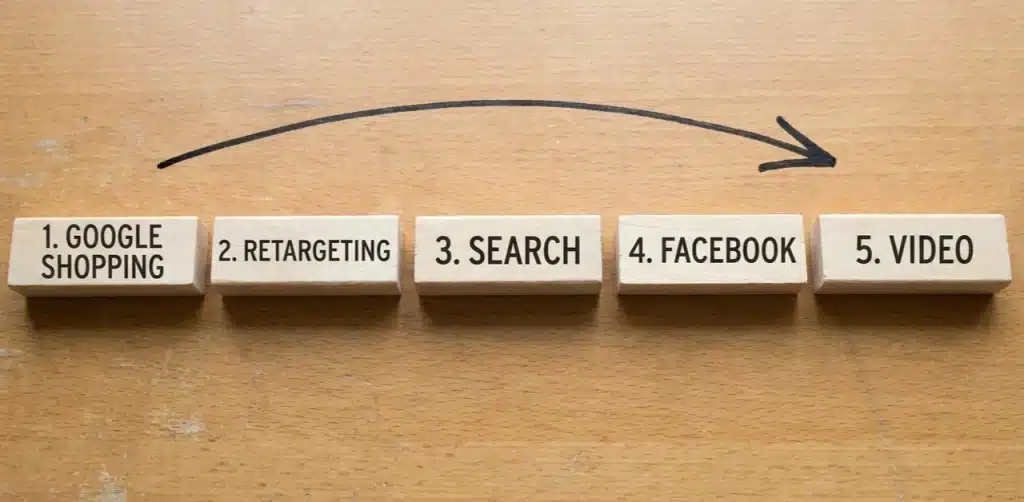
Here’s the full sequence, in the order it should usually happen for a Shopify store.
- 1. Google Shopping. Product tiles at the top of search, pulled from your product feed through Merchant Centre. Cheapest high-intent traffic in the mix and the backbone of most ecommerce accounts. Full detail in our guide to Google Shopping ads in Australia.
- 2. Retargeting. Once Shopping is sending traffic, retargeting closes the people who looked and left. Dirt cheap, high ROAS, and close to free money because the audience already knows you. Runs on both Google Display and Meta catalogue ads.
- 3. Google Search. Text ads for category and problem searches, plus a cheap brand campaign to defend your own name. Around AUD $1.67 a click for ecommerce, the cheapest of any industry, mostly because ecommerce buyers convert on Shopping instead.
- 4. Facebook & Instagram. Once the store’s proven it converts, Meta fills the top of the funnel by creating demand among people who aren’t searching. This is where creative becomes the whole game. Full detail in our Facebook ads for Shopify guide.
- 5. YouTube, Demand Gen and TikTok. Awareness and demand creation with video, for stores where the earlier channels are already profitable and you want more volume than search demand can supply. Last, not first.
The order isn’t sacred, but the principle is: harvest existing demand before you pay to create new demand, and don’t turn on a channel before you’ve got the data or the traffic to feed it. Karen from AgencyLand starts everyone at step four with a “brand awareness” campaign, because it’s the one where nobody can prove it didn’t work.
How do Google and Meta actually fit together?
They’re not rivals, they’re a relay. Google catches the demand that already exists. Meta creates the demand that doesn’t. Retargeting stitches the two together by catching the people who bounced off either one.
Picture a customer’s actual path. They see your product in their Instagram feed (Meta created the demand). They don’t buy, but a week later they Google your brand or your product category (Google harvests it). They click a Shopping ad, browse, leave. That afternoon a retargeting ad brings them back to finish the purchase. Three touchpoints, three channels, one sale, and if you’d only run one of them you’d have paid more for a worse result or missed the sale entirely.
This is why judging Facebook by its standalone ROAS is a trap. Meta’s number looks worse on the spreadsheet because it did the early, expensive work that made the cheap Google conversion possible. Cut it and the Google number quietly gets worse too, because the demand it was harvesting stops being created.
What about the platforms everyone argues about?
A few quick honest calls on the channels that generate the most debate:
- TikTok. Real for the right product: visual, impulse-friendly, younger buyer. Wrong for plenty of others. It’s a demand-creation channel like Meta, not a harvesting one, so it sits late in the sequence and only if your product genuinely fits the platform.
- The Shopify “boost” and one-click ad tools. Convenient, and they’ll spend your money efficiently on the wrong objective. Native boosting optimises for engagement, not purchases. Fine for a quick test, not a strategy.
- Influencer and affiliate. Legitimate, but it’s a different discipline to paid ads and outside what we do. Worth it for some stores, a distraction for others.
- Pinterest. Quietly strong for certain categories (homewares, fashion, weddings, food), overlooked because it’s unfashionable. Worth a look if you’re in one of those niches.
Should you run your Shopify ads yourself?
If you’re under about $2k a month and just starting, learning it yourself is a fair call. The sequence above will get you further than most paid courses, Shopify’s built-in integrations have made the plumbing genuinely easier than it used to be, and there’s real value in understanding your own numbers before you hand them to anyone.
Where it flips is when real money’s moving and the store’s growing. The gap between a sequenced, well-tracked account and a scattered one is worth multiples of any management fee, and running Google and Meta properly at the same time (feeds, creative refresh, tracking, seasonal pacing) is a weekly job, not a set-and-forget one. That’s the point where a specialist stops being a cost and starts being maths.
If you get there, we’re an eCommerce ads agency that runs Google and Meta for Australian online stores, and nothing else. No SEO, no web design, no social media management. Just the ads. You deal with me and my small team directly. No middlemen. No contracts. No fluff.
Say G’day if you want a straight answer on which channel your store should start with. And if the honest answer is that you’re not ready for paid ads yet, or your Shopify setup needs fixing first, I’ll tell you that too.
Shopify ads FAQ
What are the best ads for a Shopify store?
There’s no single best channel. Google Shopping catches people already searching for your product and is usually the cheapest high-intent traffic. Facebook and Instagram create demand among people who aren’t searching yet. Most stores need both, plus retargeting to close visitors who didn’t buy first time. The best ad is the one that matches where your buyer is right now.
How much does it cost to advertise a Shopify store?
You set the budget, so the real question is what’s enough to work. Most Australian stores start Google Shopping at $2k to $5k a month and Facebook at around $3k, because both algorithms need conversion data to optimise. To run both properly, budget somewhere north of $5k a month combined. You can start smaller on one channel, but spreading a tiny budget across both starves each of data.
Should I use Google or Facebook ads for my Shopify store?
Most stores need both, because they do different jobs: Google harvests existing demand, Facebook creates new demand. If budget forces a choice, start with Google Shopping, since catching people already searching is the fastest path to first profit. Add Facebook once the store’s proven it converts, to grow the top of the funnel.
Can I run Shopify ads myself?
Yes, especially under about $2k a month. Shopify’s built-in integrations with Google and Meta have made the setup genuinely easier, and learning your own numbers first is worth doing. It gets harder to DIY once real money’s moving, because running Google and Meta together well is a weekly job involving feeds, creative, tracking and seasonal pacing, not a set-and-forget task.
Do Shopify ads work for small stores?
They can, provided the maths works. A small store with decent margins and a focused budget competes fine, because Google Shopping clicks are cheap and retargeting is cheaper. What sinks small accounts isn’t size, it’s spreading a thin budget across too many channels and campaigns, leaving no single one with enough data for the algorithm to learn from.
What’s the difference between Google Shopping and Facebook ads for Shopify?
Google Shopping shows product tiles to people actively searching for what you sell, so it harvests existing intent and usually shows a higher ROAS. Facebook shows ads to people who aren’t searching, creating demand earlier in the journey, so it costs more per click and reads lower on ROAS while doing work that feeds the whole funnel. Different jobs, and most stores run both.